Ask a professor what they don’t trust about AI, and you’d expect a story about robots replacing teachers, or a rant about kids cheating. You’d also expect ten different professors to hand you ten different answers. We got neither. Across the faculty we spoke with, the forums and surveys we read, and the FDPs where the topic came up unprompted, the same handful of complaints kept showing up, no matter the subject, the institution, or how long someone had been teaching.
1. It’s too taxing to learn a new tool, only to generate vague answers
Learning a new AI tool takes time on its own. That part isn’t the problem. What actually wears faculty down is what happens after: anything the tool generates still has to be checked against what’s true and be customized to the syllabus. That verification work often takes longer than the task would have taken without the tool in the first place.
Stack the learning curve on top of the time it takes to check the work, and the tool doesn’t save a professor time. It adds a second job on top of the first: one more thing to manage, one more thing to double-check, on a Tuesday that already had fifteen other things on it. That same complaint keeps showing up outside our own conversations too, in interviews with researchers who study AI’s role in the classroom.
2. The inconsistency in today’s LLMs makes tenured faculty wary
Professors using AI tools to teach often face inconsistent data points, user bias, and unverified references. Researchers studying faculty reluctance to AI have found a similar root cause: faculty weren’t against the technology itself; they just hadn’t been given the training or support to actually trust it. The distrust wasn’t about the tool. It was about being handed one and left to sort out the rest alone.
Teacher forums tell a similar story. Teachers who still use AI mostly say the same thing: use it sparingly, and check the output yourself before a student ever sees it. The teachers who skip that step end up as the cautionary tales in those same discussions, like the exam question that went out unsolvable because nobody checked it first, and cost students real time on a high-stakes paper.
How Edwisely addresses the distrust
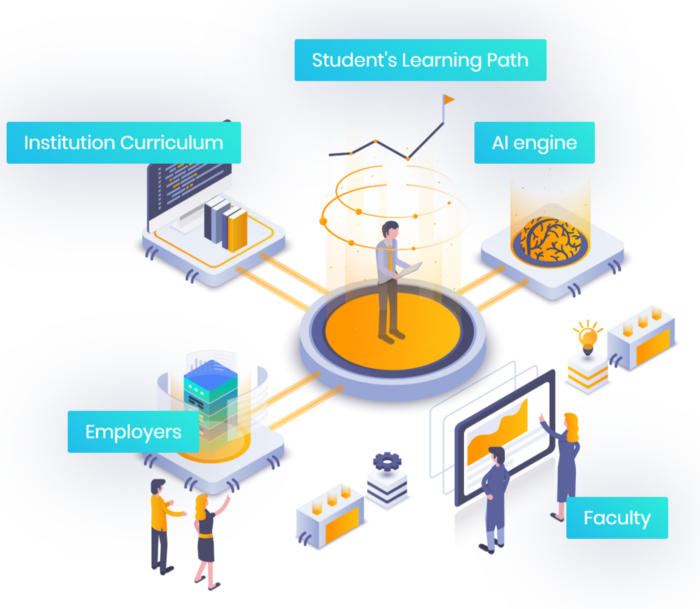
We built Intelligent Learning Infrastructure for faculty as much as for students. We wanted a layer that gave them back time for research, for developing teaching and learning outcomes, and for actually engaging students. We addressed ease of use head-on: every rollout starts with a pilot for the university’s faculty and students.
The tasks we hand to AI start as a draft, not a finished answer. Tools like Lesson Planner, Concept Explainer, and Lesson Hooks give a professor something to react to when they’re building a class, a starting point instead of a blank page. The part that’s genuinely not automated is the part that decides what belongs in that class in the first place: the interactive sessions that go deep into a topic, meet real student curiosity, connect to real-life application, and give students an easy way to engage and test what they know.
When a college onboards ILI, we start with their syllabus and textbooks. Our academic team then customizes the repository of topics to that college’s exact course structure: mapping the university’s own course outcomes to the right topics and keeping the material current to what’s actually being taught that term. The practice material underneath it, MCQs, flashcards, simulations, text- and image-based questions, even material built around NPTEL content- gets written for that specific course.
TEATAR, our teaching framework, is built to take on tasks like: mapping out courses, running tests, forming groups for case studies, matching test questions to Bloom’s taxonomy levels, and the dozen other things that eat a professor’s day without ever counting as teaching. The control is completely left to the faculty; nothing gets published without their approval.
The Teams That Build Faculty Trust
The academic team isn’t a separate layer we bring in to reassure faculty after the fact. They’re the same people doing the topic-wise CO mapping, building the content repository, and customizing every rollout to a university’s actual syllabus, which means integrity and customization aren’t two different jobs at Edwisely. They’re one job, done by one team, for every institution we work with.
Throughout, a customer success manager stays on campus, walking faculty through each feature and answering questions as they come up. The automation sits inside the workflow they already use to teach, assess, and track a section, not in a new tab they have to remember to open.
What the time is actually for
None of this is really about AI. It’s about what a professor does with the hours it gives back. Fewer hours on outcome mapping means more time in office hours, actually reading a student’s third draft instead of skimming it, finishing a research paper that’s been half-written since last semester. AI’s job in a classroom is to clear out everything that was never really teaching in the first place: the paperwork, the tracking, the reformatting of the same data into three different systems. Every complaint on that list came from somewhere real. The only way to change their mind is to build something that doesn’t give them a reason to repeat it.