

Over the past decade, higher education institutions invested billions in Learning Management Systems (LMS) and Enterprise Resource Planning (ERP) platforms.
The promise? Digitize content, automate administration, and manage academics at scale.
And it worked….for a while.
But these systems were built for a different era. An era where:
- Learning meant consuming content (not applying knowledge)
- Assessment meant standardized tests (not real-world problem-solving)
- Personalization wasn’t expected (one-size-fits-all was acceptable)
That era is over.
Today, students graduate into a job market where roles evolve faster than curricula and where AI has already transformed how knowledge is created and applied. Employers demand graduates who can think critically, solve ambiguous problems, and articulate solutions, not just recall information. Faculty need actionable insights to guide teaching, not data dumps from disconnected systems. And AI has fundamentally shifted the question in education: from “Can students access information?” to “Can they think with it?”
Yet most institutions are still running on 2010 infrastructure.
The limitations are becoming impossible to ignore:
1. Personalization is bolted on, not built in. Institutions attempt to personalize learning by layering rules, logic, or AI tools onto systems that were never designed to adapt. The result? Brittle pathways that break when students deviate from predefined routes. One unusual learning pattern, and the system fails.
2. Data is fragmented, not connected. Attendance data lives in one system. Assessment data in another. Engagement metrics in a third. Faculty need to manually stitch together insights from multiple platforms just to understand: Is this student actually learning?
3. Questions answered are operational, not strategic. LMS tells you: “Was the assignment submitted?” But it can’t answer: “Does this student understand the underlying concept? Where are they struggling? What intervention would help?”
4. The gap between what learners need and what systems deliver is widening.
- Students need adaptive learning paths based on their pace and style.
- Faculty need real-time insights to intervene before students fail.
- Institutions need proof that learning outcomes are being achieved.
Traditional LMS/ERP can’t deliver any of this because they weren’t built to.
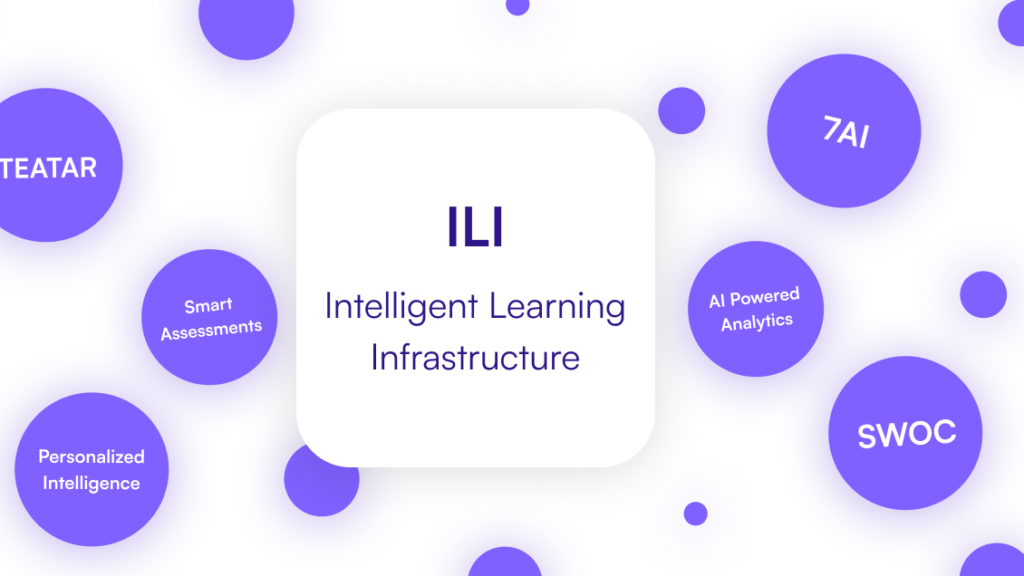
This is why higher education needs Intelligent Learning Infrastructure.
Not as a replacement for every system. But as an intelligence layer that:
- Analyses how each student learns (not just what they submit)
- Guides faculty with actionable insights (not overwhelming dashboards)
- Adapts in real-time to learning patterns (not rigid, predefined paths)
- Connects fragmented data into coherent academic intelligence
The institutions that recognize this shift aren’t just upgrading their LMS.
They’re fundamentally rethinking what academic infrastructure should do.
The Edwisely Approach
Edwisely is an AI-first education company founded by alumni of IIT Madras and TU Delft. The work at Edwisely is grounded in a clear principle: academic systems should support educators and learners without adding complexity.
Edwisely ILI is designed to integrate into existing institutional workflows and support long-term academic goals. At its core are two complementary intelligence models that together form the foundation of ILI.
The Heart of ILI — TEATAR and 7AI
TEATAR: Teaching Intelligence for Faculty
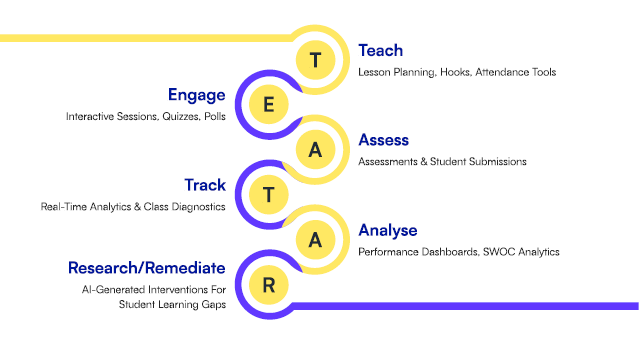
TEATAR is the teaching intelligence model within Edwisely ILI. It supports faculty across the complete academic lifecycle.
TEATAR represents:
Teach | Engage | Assess | Track | Analyze | Remediate / Research
Rather than treating these stages as independent tasks, TEATAR connects them into a continuous, data-informed loop that supports instructional clarity and timely intervention.
Teach
Faculty receive structured lesson support aligned to the syllabus and outcomes. AI-supported lesson hooks and explanations help present concepts clearly while addressing varied learner needs.
Engage
Engage enables interactive classroom participation through structured activities and collaborative tools. Faculty gain immediate inputs related to attention, participation, and conceptual understanding.
Assess
Assessments are designed to be frequent and meaningful. AI-assisted creation and evaluation help identify learning gaps early, without increasing grading effort.
Track
Learning progress is tracked continuously. Faculty can view performance and engagement trends through simple dashboards.
Analyze
Teaching data is analysed at the concept and unit level. This helps faculty understand what is effective and where adjustments are required during the course.
Remediate / Research
Based on identified gaps, TEATAR recommends targeted remedial actions. Teaching data also supports reflective practice and academic research.
TEATAR reduces administrative effort while preserving academic autonomy. Faculty retain full control, supported by structured insight rather than manual reporting.
7AI: Learner Intelligence for Students
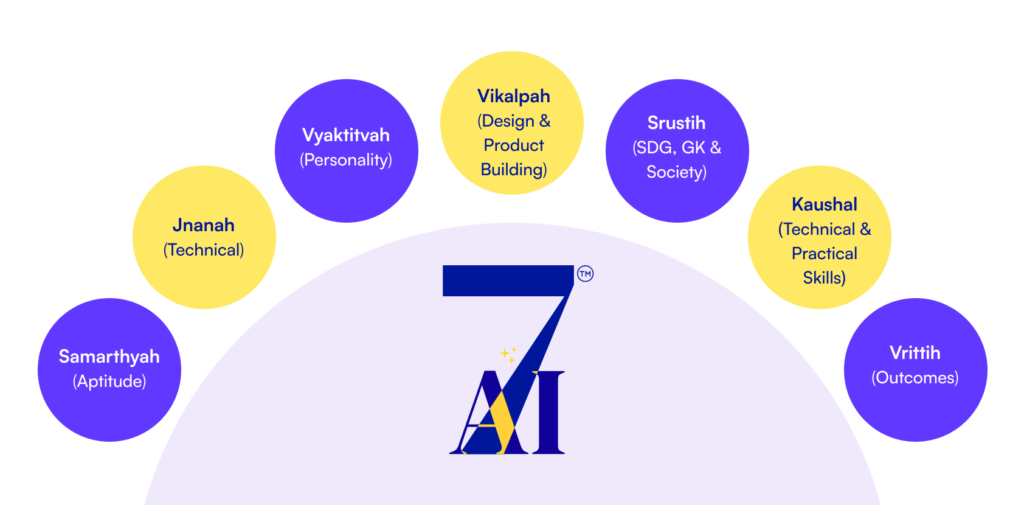
7AI forms the learner intelligence layer of Edwisely ILI. It enables institutions to understand students beyond marks and attendance.
7AI provides a continuous, multidimensional view of each learner across seven dimensions.
Samarthyah
Captures aptitude and cognitive capability, helping identify learning agility and problem-solving potential early.
Jnanah
Tracks conceptual understanding and subject mastery, ensuring learning is cumulative and progressive.
Vyaktitvah
Provides insight into personality traits using the Big Five framework, supporting self-awareness and informed mentoring.
Vikalpah
Assesses computational thinking and coding fluency, enabling exploration of technical pathways through practice.
Srustih
Captures awareness beyond the classroom, including global issues, social responsibility, and sustainability alignment.
Kaushal
Focuses on practical skills and certifications, highlighting applied strengths and areas for further development.
Vrittih
Aligns learning with career direction, supporting informed exploration of professional pathways.
Together, these dimensions form a living learner profile that evolves over time.
TEATAR and 7AI work together within Edwisely ILI to connect teaching intelligence with learner intelligence.
The Outcomes
- Faculty gain clarity on teaching impact.
- Students receive structured and personalised guidance.
- Leadership gains real-time academic insight.
This integrated approach enables institutions to move from managing academic processes to designing learning experiences at scale.
Intelligent Learning Infrastructure is not a trend. It is becoming a foundational requirement for institutions that aim to lead with clarity, accountability, and academic purpose in the AI era. At Edwisely, the focus is on integration with your institution, not just familiarization. The result is a personalized infrastructure you can truly call yours.