A response to QS Insights Magazine #44
QS Insights Magazine’s latest edition makes a case most Indian institutions already agree with: university-industry partnerships matter more than ever.
The harder question is what makes them actually work.
Most partnerships between Indian engineering institutions and industry follow a familiar pattern. An MoU is signed. A guest lecture series runs. Students complete internships. Placement numbers are reported.
What rarely happens is this: anyone checks whether the student who completed the internship came out of it more capable than one who didn’t. Whether the industry partner’s input into the curriculum produced graduates who were measurably better prepared. Whether the partnership, in any traceable way, changed a student’s trajectory.
This isn’t a problem of intent. It’s a problem of visibility.
What Industry Partners Actually Need
When industry partners engage with institutions, they are making an investment — of time, of mentorship, of curriculum input. Like any investment, they want to know whether it produced a return.
Right now, most institutions cannot tell them. Not because the outcomes don’t exist, but because the infrastructure to surface them doesn’t.
A genuine industry partnership needs three things to work at scale:
- a way to track what students are learning and how they’re developing across the semester,
- a mechanism to map that development to the outcomes the industry partner cares about, and
- a shared view of the data that both the institution and the partner can act on.
- Without these, the partnership is built on goodwill. Goodwill is fragile. Data is durable.
What ILI Makes Possible
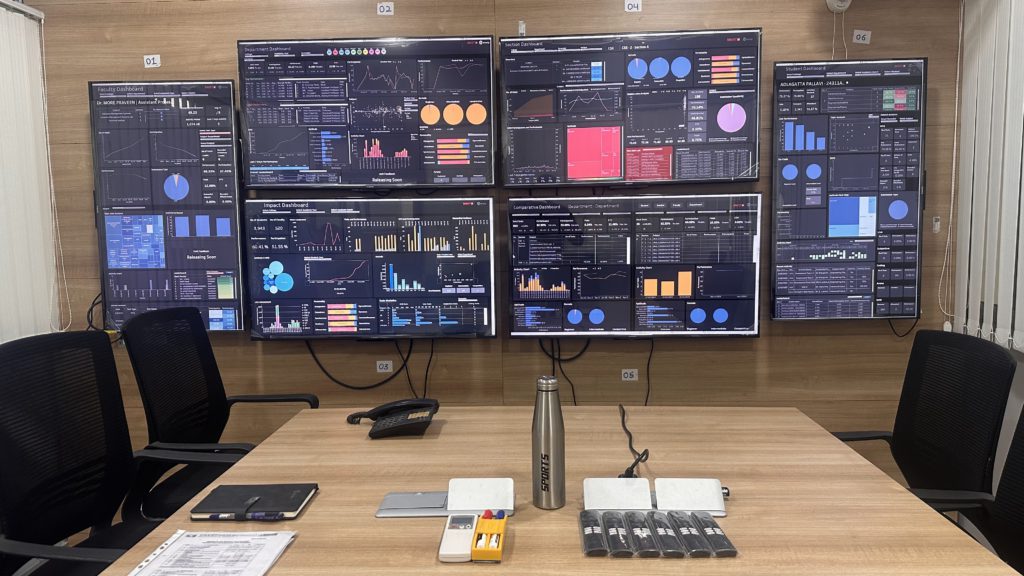
Intelligent Learning Infrastructure is the layer that makes university-industry partnerships measurable.
When an institution runs ILI, every assessment, every engagement, every learning interaction produces data that maps to course outcomes, program outcomes, and graduate attributes. Faculty can see, mid-semester, whether students are developing the applied capability that an industry partner’s curriculum input was designed to build. Leadership can see, across cohorts, which partnerships are producing the strongest outcomes and where the gaps are.
For industry partners, this changes the relationship entirely. Instead of contributing to a process and waiting for placement numbers, they get visibility into the pipeline — early, specific, and actionable.
For institutions, it means every industry partnership becomes a source of evidence. Evidence for accreditation. Evidence for rankings. And most importantly, evidence that the collaboration is producing something real for students.
The Partnership India’s Institutions Actually Need
QS’s employer reputation rankings are a signal worth paying attention to. India’s universities are rising fast on research metrics. The employer reputation signal has not kept pace.
The gap is not about the quality of students. It is about the ability of institutions to demonstrate, with data, what their graduates can actually do.
ILI is built for exactly this — not as a replacement for industry relationships, but as the infrastructure that makes those relationships visible, measurable, and worth sustaining.
If your institution is building industry partnerships and wants them to produce outcomes that hold up beyond the next placement season, this is the conversation worth having.
Inspired by QS Insights Magazine #44 — “Why University-Industry Partnerships Matter More Than Ever”