Course Outcome (CO) attainment lies at the core of academic quality, outcome-based education, and accreditation readiness. It is the primary mechanism through which institutions evaluate whether teaching and learning are achieving their intended goals.
Yet in many institutions, CO attainment is still treated as a post-semester activity—compiled through spreadsheets, manual calculations, and retrospective reporting.
This approach satisfies documentation requirements, but it often fails to influence learning in a meaningful way.
The Challenge with Traditional CO Attainment Practices
Conventional CO attainment processes typically involve:
- Manual mapping of assessments to COs
- Spreadsheet-based calculations
- End-semester consolidation of data
- Static reports prepared for audits
While these steps produce numbers, they introduce several limitations:
- Insights arrive too late to support intervention
- Data remains disconnected from day-to-day classroom activity
- Faculty effort increases without corresponding academic value
- Leadership receives reports, not understanding
CO attainment becomes a compliance exercise rather than a learning tool.
Why CO Attainment Needs a Shift
In an outcome-based education framework, outcomes are not meant to be checked after learning concludes. They are meant to guide teaching and learning as it happens.
For CO attainment to serve its purpose, institutions need to know:
- Which outcomes are being achieved during the course
- Where attainment is falling short, and why
- Whether interventions are improving learning quality
- How teaching practices relate to outcome achievement
These questions cannot be answered through retrospective reporting alone.
CO Attainment Within Intelligent Learning Infrastructure
Within Edwisely’s Intelligent Learning Infrastructure (ILI), CO attainment is embedded into everyday academic workflows.
Rather than being calculated at the end of a semester, attainment is:
- Captured continuously through assessments and activities
- Automatically mapped to defined COs and POs
- Calculated in real time using consistent logic
- Presented as live academic insight rather than static reports
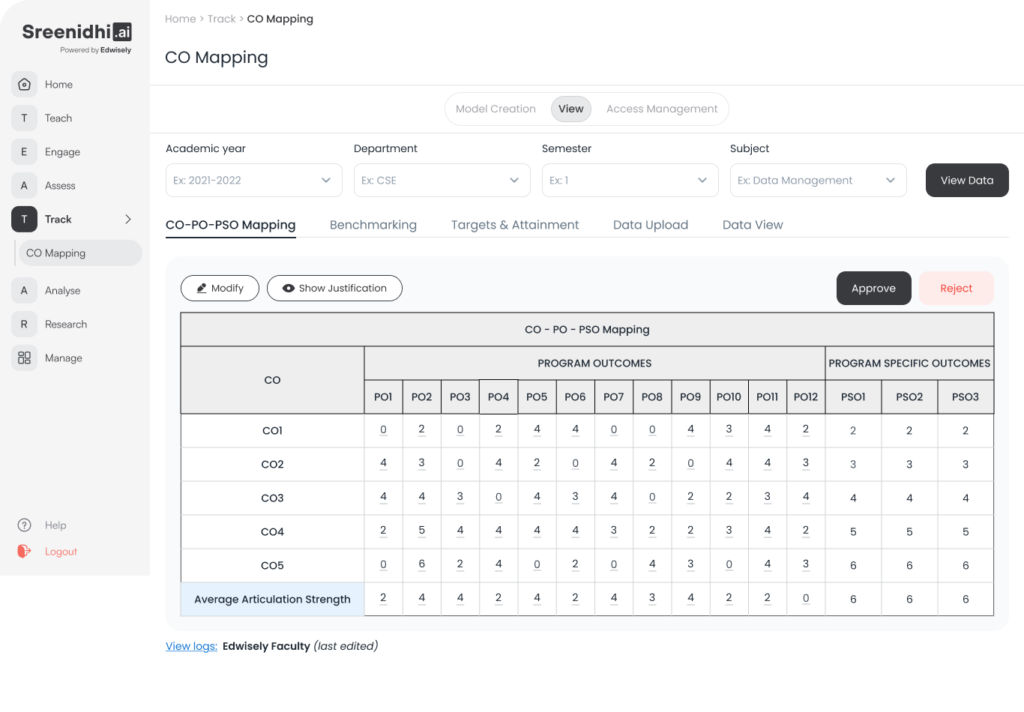
This ensures that outcome tracking reflects actual learning progress.
How Automated CO Attainment Works
The process follows a structured academic flow:
- Assessments and activities are aligned to defined COs
- Evidence is captured automatically as learning occurs
- Attainment levels are computed continuously
- Gaps against defined targets are identified early
- Faculty and leadership gain visibility while action is still possible
Automation does not remove academic judgement. It removes repetitive manual work.
Supporting Faculty Without Increasing Load
One of the key concerns with CO attainment is faculty workload. Manual mapping, calculation, and report preparation consume time without directly improving learning.
ILI addresses this by:
- Eliminating spreadsheets and duplicate data entry
- Applying standardised attainment logic across courses
- Allowing faculty to focus on interpretation and action
Faculty move from compiling data to using insight.
Institutional and Accreditation Impact

From an institutional perspective, automated CO attainment strengthens governance and accountability.
It supports:
- Clear alignment with OBE principles
- Consistent CO–PO mapping across programs
- Audit-ready evidence for NBA and NAAC
- Program- and department-level attainment visibility
Reports are always current, defensible, and traceable to actual academic activity.
From Reporting to Continuous Improvement
When CO attainment becomes continuous, its role changes.
Institutions move from asking:
“Have we completed the report?”
To asking:
“Are our outcomes being achieved, and what should we do next?”
This shift enables:
- Timely academic intervention
- Evidence-based curriculum refinement
- Stronger alignment between teaching, assessment, and outcomes
From Outcome Tracking to Outcome Improvement
CO attainment was never meant to be an administrative formality. It was designed as a mechanism to improve academic quality.
When embedded within Intelligent Learning Infrastructure, CO attainment becomes a living indicator of learning effectiveness, not a semester-end obligation.
Institutions that treat outcomes as ongoing signals—rather than final numbers—are better positioned to sustain quality, accountability, and academic purpose in the AI era.