Higher education has always aimed to develop problem solvers. Yet in many classrooms today, problem solving has narrowed to answering predefined questions with known solutions. Students learn how to score, but not always how to think.
Assignments are completed. Answers are submitted. Grades are recorded.
However, meaningful learning often remains limited.
This gap becomes visible when students encounter real-world problems—problems that are open-ended, ambiguous, and require judgement rather than recall.
Case study–based learning within Intelligent Learning Infrastructure (ILI) is designed to address this gap.
The Limits of Traditional Assignments
Most assignments follow a familiar structure:
- Faculty prepare questions
- Students submit written responses
- Faculty evaluate and assign marks
Over time, this approach presents several challenges:
- Students rely on copied or AI-generated responses
- Answers follow predictable templates
- Original thinking declines
- Faculty spend time correcting without insight into reasoning
Assignments get completed, but learning depth does not always improve.
These challenges are structural rather than instructional. They reflect a mismatch between traditional assessment formats and the skills institutions expect graduates to develop.
How ILI Case Studies Reshape Learning
Case studies shift the focus from answers to decisions.
They place students within realistic scenarios that require them to:
- Understand context
- Analyse incomplete information
- Consider multiple perspectives
- Justify choices
- Defend reasoning
There is no single correct answer. There is only well-reasoned judgement.
This approach mirrors how professionals operate in real environments. It is also how engineers learn to think beyond formulas and procedures.
Case Studies Within Intelligent Learning Infrastructure
Within Edwisely’s Intelligent Learning Infrastructure, case studies are designed as structured learning experiences rather than isolated classroom activities.
They are:
- Aligned with curriculum and learning outcomes
- Guided by clear academic intent
- Scalable across large cohorts
- Measurable in terms of learning outcomes
Case studies are available for core subjects, and faculty can also design their own based on course requirements.
How Case Studies Work in Practice
ILI case studies follow a structured two-phase approach.
Individual Exploration
Students are assigned defined roles within a case, each reflecting a real-world responsibility.
During this phase:
- Students analyse the case from their assigned perspective
- AI-guided questioning challenges assumptions and reasoning
- Conceptual understanding is tested through explanation and analysis
This ensures individual accountability and depth of engagement.
Group Collaboration
After individual exploration, students collaborate as a group.
In this phase:
- Students present their findings
- They question and refine each other’s thinking
- They integrate perspectives to arrive at a practical solution
AI moderation supports focused and inclusive discussion. This phase develops collaboration, communication, and structured problem-solving.
Faculty Visibility Without Additional Workload
Case studies within ILI do not increase faculty workload. They increase academic visibility.
Faculty can review:
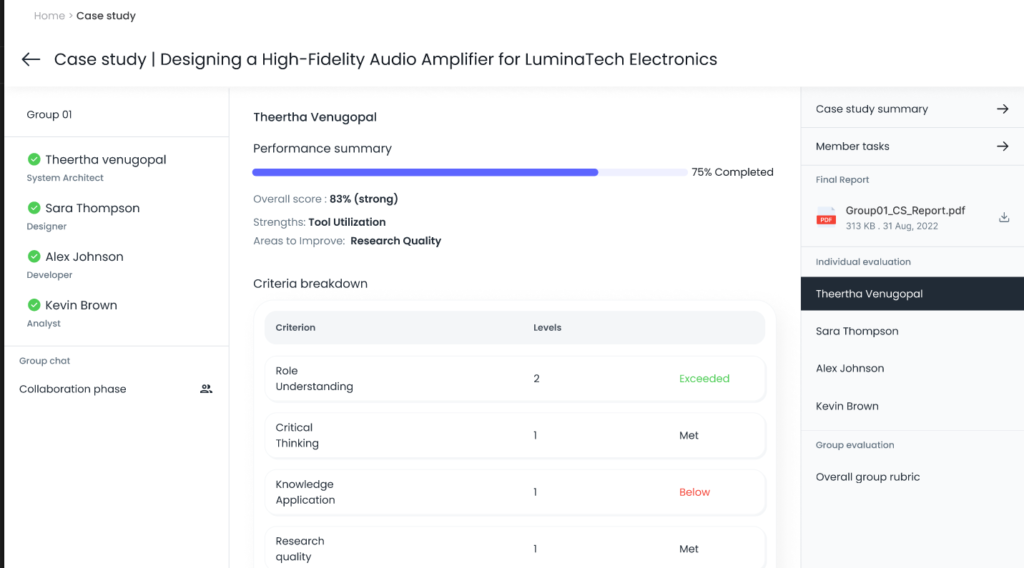
- Individual contribution
- Quality of reasoning
- Role understanding
- Depth of analysis
- Group collaboration
Evaluation remains structured and evidence-based, without requiring manual coordination.
The Role of Customised Rubrics in ILI Case Study Learning
Rubrics are central to ensuring that case study–based learning remains structured, fair, and outcome-driven—especially when implemented at scale.
Within ILI, rubrics are customised to the case, the subject, and the learning outcomes. They are designed to evaluate how students think, not just what they submit.
Each case study rubric typically assesses:
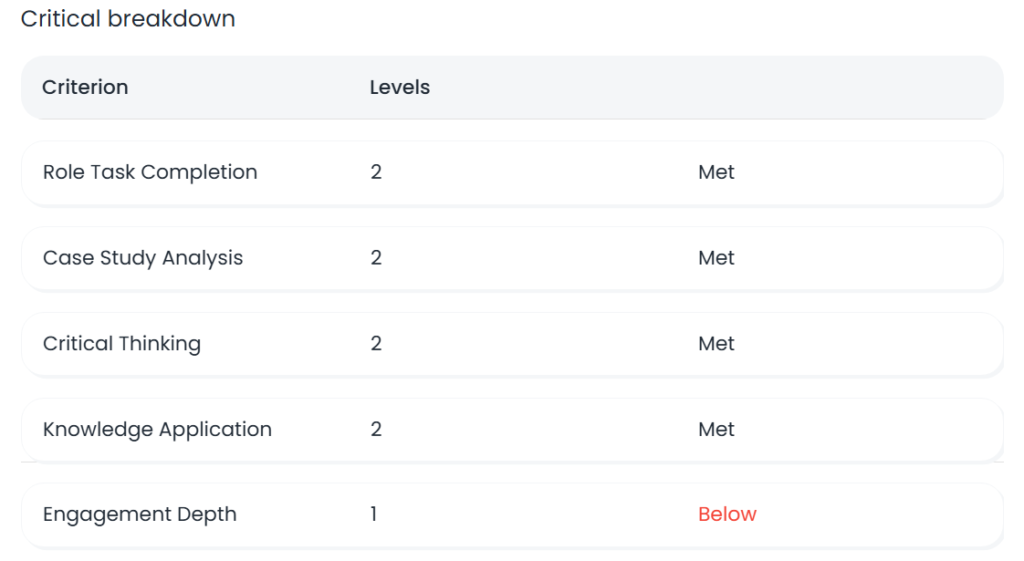
- Understanding of the assigned role and context
- Depth and logic of reasoning
- Application of subject concepts to real situations
- Quality of analysis and decision-making
- Contribution to group discussion and solution development
These rubrics are:
- Shared with faculty, who can review, refine, or modify them based on academic judgement
- Applied consistently across cohorts to ensure fairness and transparency
- Visible to students, helping them understand expectations, reflect on performance, and improve meaningfully
By anchoring evaluation in customised rubrics, ILI ensures that open-ended learning remains measurable without becoming restrictive.
Institutional Impact
Case study–based learning supported by structured rubrics contributes to several institutional priorities.
Stronger Learning Outcomes
Students move from memorising concepts to applying them in context.
Improved Engagement
Participation increases when learning feels relevant and purposeful.
Alignment with NEP and OBE
Case studies naturally support outcome-based education and competency development.
Faculty Efficiency
Structured frameworks reduce the effort required to design, manage, and evaluate complex activities.
Graduate Readiness
Students develop reasoning, collaboration, and decision-making skills aligned with real-world expectations.
From Assignments to Learning Experiences
ILI Case studies redefine the role of assignments. They become learning experiences rather than submission exercises.
Students stop asking, “What is the answer?”
They begin asking, “What is the most appropriate decision, and why?”
Looking Ahead
Institutions that embed case studies into regular academic practice prepare students for complexity, not just examinations.
Within Edwisely ILI, case studies are not an add-on. They are a core method to develop critical thinking at scale—supported by structure, insight, and academic intent.
This is how institutions ensure that students do not merely pass, but learn to solve.